

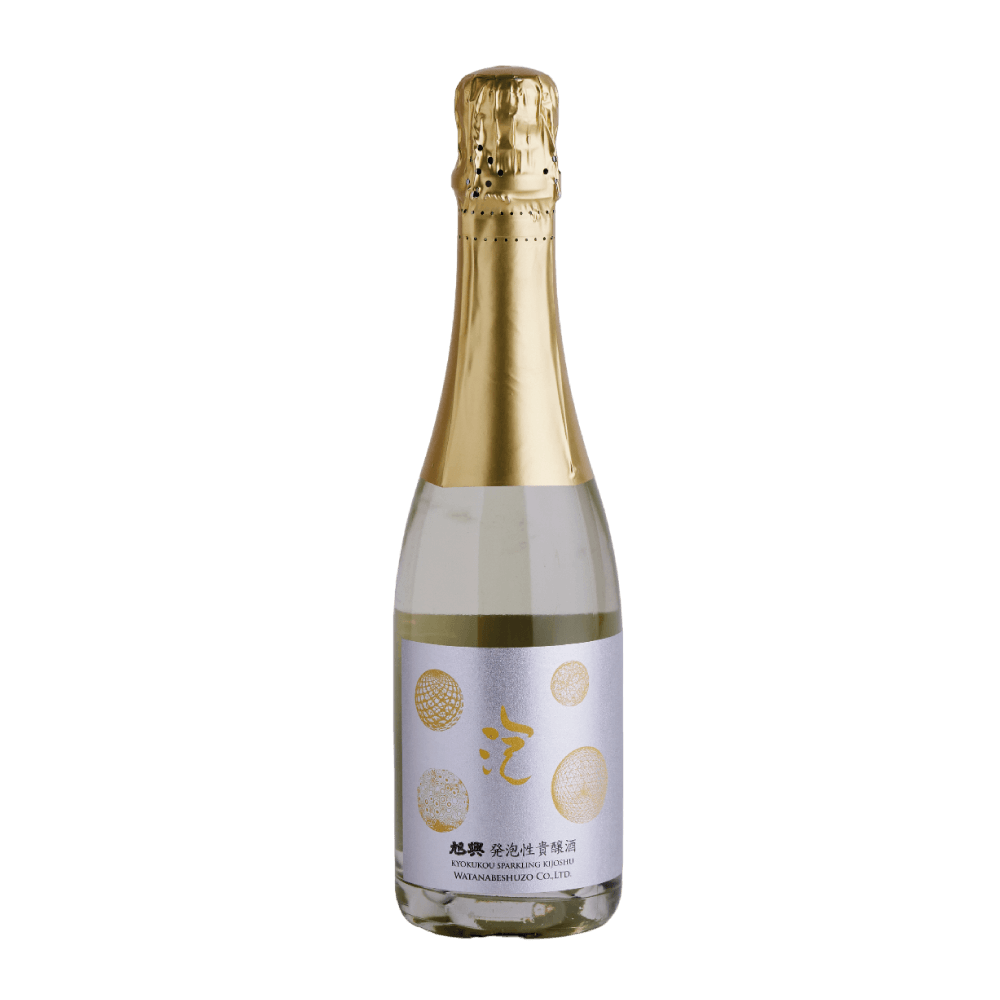
Kyokuko Sparkling Kijoshu - 375ml
Kyokuko Sparkling Kijoshu is complete different from any other sake with bubbles through the unique Kijoshu brewing method. With this special method, a full powerful sweet sake is created with a very nice balance between the sweet on the one hand and the acids in the sake on the other. A sublime lush sake with bubbles is the result. Nice mousse, nice fruit in the nose and on the pallet, lots of umami and a fantastic fine aftertaste.
When brewing sake, the Moromi tank is normally filled in three steps for four days. The first day the tank is filled for 1/6 with the yeast starter, steamed rice, koji rice and water. The second day is not done anything, the third day the quantity in the tank is doubled, then 2/6 steamed rice, Koji and water is added. The fourth day this amount is doubled with the addition of 3/6 tank of steamed rice, koji and water. With the Kijoshu method, the fourth day of sake is added instead of water, making the sake much sweeter and fuller after fermentation than with the normal method.
This sake can be served with desserts but also as a apertif.
This sake is best served cold in a flûte.
| Prefecture: | Tochigi |
|---|---|
| Alcohol: | 12.0% |
| Classification: | Junmai |
| Style: | Kijoshu, Sparkling |
| Content: | 375ml |
| Rice polishing ratio: | 60% |
| Rice type: | Hitogokochi |
| SMV: | -76 |
| Acidity: | 4.2 |
| How to serve: | Reishu 冷酒 (refrigerated) |
| Importer: | Sake.nl - own exclusive import |
Product information "Kyokuko Sparkling Kijoshu - 375ml"
Kyokuko Sparkling Kijoshu is complete different from any other sake with bubbles through the unique Kijoshu brewing method. With this special method, a full powerful sweet sake is created with a very nice balance between the sweet on the one hand and the acids in the sake on the other. A sublime lush sake with bubbles is the result. Nice mousse, nice fruit in the nose and on the pallet, lots of umami and a fantastic fine aftertaste.
When brewing sake, the Moromi tank is normally filled in three steps for four days. The first day the tank is filled for 1/6 with the yeast starter, steamed rice, koji rice and water. The second day is not done anything, the third day the quantity in the tank is doubled, then 2/6 steamed rice, Koji and water is added. The fourth day this amount is doubled with the addition of 3/6 tank of steamed rice, koji and water. With the Kijoshu method, the fourth day of sake is added instead of water, making the sake much sweeter and fuller after fermentation than with the normal method.
This sake can be served with desserts but also as a apertif.
This sake is best served cold in a flûte.
| Prefecture: | Tochigi |
|---|---|
| Alcohol: | 12.0% |
| Classification: | Junmai |
| Style: | Kijoshu, Sparkling |
| Content: | 375ml |
| Rice polishing ratio: | 60% |
| Rice type: | Hitogokochi |
| SMV: | -76 |
| Acidity: | 4.2 |
| How to serve: | Reishu 冷酒 (refrigerated) |
| Importer: | Sake.nl - own exclusive import |
Watanabe Shuzo een kleine familie sakebrouwerij in de Nasu-regio in het noorden van de prefectuur Tochigi. In 1892 startte Eisaku Watanabe, wiens familie al generaties lang sakebrouwers was in de prefectuur Niigata, een sakebrouwerij in een gehuurd opslaggebouw op een boerderij in de prefectuur Tochigi. In 1912 werd de brouwerij verplaatst naar de huidige locatie in het Susagi-gebied van Otawara City, en omdat de verhuizing de brouwerij verder naar het oosten bracht dan de oorspronkelijke locatie, werd de naam van het merk veranderd in Kyokuko, wat 'rijzende zon' betekent.
De huidige hoofdbrouwer Hidenori Watanabe vertegenwoordigt de vijfde generatie van zijn familie die aan het hoofd staat van het bedrijf. Een bewijs van de vaardigheid van Watanabe is de certificering als Nanbu Toji (meesterbrouwer) en het claimen van de eerste prijs in de ‘Nanbu Toji Contest’, een prestatie die veel deelnemers als een absoluut ‘bucketlist’-item beschouwen. Hij wint ook jaarlijks prijzen op evenementen zoals de Japanese Sake Awards, IWC en die van de Amerikaanse National Sake Appraisal. Hoewel het bedrijf traditionele methoden gebruikt, zoals het brouwen van Kimoto en Yamahai sake, werkt het ook aan de productie van innovatieve sake die past bij de moderne voedingsstijl, zoals kijoshu, mousserende sake en rode sake.
How we pack your order
Safe & careful packaging
- Every sake bottle is individually wrapped and secured with shock-absorbing materials.
- Reinforced dividers keep bottles from touching.
- Box sizes: 1, 3, 6 and 12 bottles—combined so everything fits snugly.
- Premium/limited editions receive extra protection (neck/base guards + added cushioning).
Temperature control
- To preserve flavour and aroma we use insulated packaging and, when needed, cold packs.
- Summer/Winter protocol: during heat or cold snaps we adjust packaging and dispatch day.
- Moisture-resistant inner layer used where appropriate to prevent condensation.
Reliable delivery
- Shipped with trusted carriers. You receive track & trace and email updates.
- Timed delivery or pickup point available (carrier dependent).
- Missed delivery? We’ll attempt again automatically or route to a nearby pickup point.
Sustainable packaging
- FSC-certified cartons and 100% recyclable void fill.
- Less plastic: paper tape and reuse of clean supplier boxes where possible.
- Compact packing to avoid shipping air and reduce CO₂.